

I’m bestselling indie writer Teague de La Plaine. This is my weekly newsletter, where I talk about writing and self-publishing in addition to my own life. I keep the newsletter free, because I prefer you spend your money on my books.

Most science fiction imagines the future as either a corporate hellscape or a shiny techno-utopia where scarcity magically disappeared offscreen. In my own writing, I wanted something different. Not perfect. Not pure. Just…workable.
The post-capitalist society in my stories didn’t emerge because humanity “solved” itself. It emerged because the old system finally failed loudly enough that it couldn’t be patched anymore.
And what replaced it wasn’t ideology. It was logistics.
The end of capitalism wasn’t a revolution—it was an exhaustion event. In the StarForce/Human Unity universe, capitalism doesn’t collapse in flames. It collapses in spreadsheets.
The symptoms are familiar to us now:
Supply chains that optimize for profit but break under stress
Housing treated as an asset class rather than shelter
Healthcare and education locked behind paywalls
Ecological systems pushed past recovery thresholds
A permanent anxiety hum humming beneath daily life
The breaking point isn’t a single war or market crash. It’s the accumulation of too many simultaneous failures. Climate displacement. Resource shocks. Automation without redistribution. Governments captured by capital but still expected to manage crises.
Eventually, markets stop being trusted to allocate what people need to live.
So humanity does what it always does in an emergency: it improvises.
The Commons Returns—But Upgraded
In my fiction, the cornerstone of the new system is the Commons.
Not the romantic medieval commons. A modern one.
Certain things are declared non-market goods:
Food staples
Housing access
Healthcare
Education
Energy
Transportation infrastructure
Information
You don’t buy these. You access them.
The question isn’t “Can you afford this?”
It’s “What does it cost the system to provide this reliably to everyone?”
And here’s the key: the system is designed around capacity, not profit.
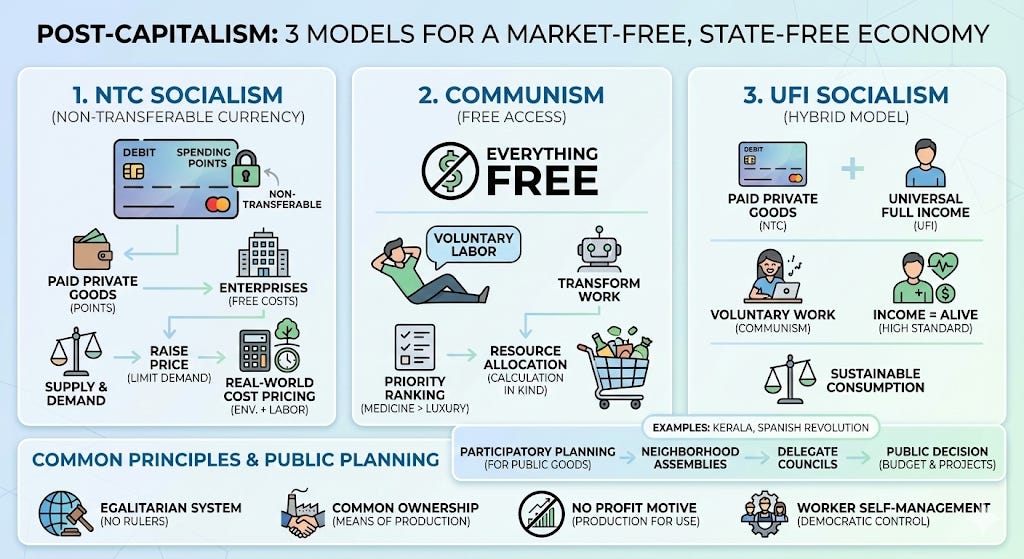
Allocation, Not Wages
People still work. A lot. Just not for money.
Instead of wages, there’s allocation credit—a measure of how much shared capacity you help maintain or expand.
Doctors, engineers, teachers, sanitation workers, farmers, system designers—everyone contributes in different ways, at different intensities, across a lifetime.
No one starves if they don’t work.
But contribution expands your access, autonomy, and influence.
The incentive structure is quiet but firm:
Contribution → trust
Trust → access
Access → freedom
Luxury still exists. Scarce goods still exist. But they’re rationed transparently, not auctioned to the highest bidder.
Status shifts away from consumption and toward competence and stewardship.
Governance Without Rulers
There’s no global emperor. No planetary president.
Instead, the system runs on nested councils:
Local
Regional
Planetary
Each layer is constrained by the one below it, not above it.
Decisions are slow by design. Systems thinking beats charisma. Metrics matter more than rhetoric. If a policy degrades human wellbeing or ecological stability, it is rolled back—no face-saving required.
Power exists, but it’s procedural, not personal.
And critically: no one gets to own the system.
Language Matters More Than You Think
In the stories, humanity adopts a common auxiliary language—not to erase culture, but to coordinate across it.
Translation costs drop. Diplomacy speeds up. Education becomes portable. Identity remains local; cooperation becomes global.
This turns out to be one of the most powerful post-capitalist technologies of all.
Shared language doesn’t create unity. But it removes friction.
So… Could Any of This Happen Here?
Not all at once. And not cleanly. But pieces of it already exist:
Public libraries
Open-source software
Universal healthcare systems
Municipal utilities
Cooperative housing
Public banking
Community land trusts
Mutual aid networks
None of these are radical. They’re boring. That’s why they work.
The real shift isn’t economic. It’s philosophical.
Capitalism assumes scarcity and competition as defaults. Post-capitalist systems assume coordination and sufficiency.
The question stops being:
“How do we grow the economy?”
And becomes:
“What level of provisioning allows humans to flourish without breaking the planet?”
That’s not utopian. It’s ecological realism.
The Quiet Part
The hardest part isn’t redesigning systems. It’s letting go of the idea that worth must be earned through suffering. In my fiction, people still struggle. They fail. They argue. They fall in love. They get bored. They dream.
The difference is this: No one is terrified of being discarded.
And that single change—more than any technology—rewires what humans are willing to build together.
Why I Write This Stuff
I don’t write post-capitalist futures because I think they’re inevitable.
I write them because they’re imaginable.
And imagination precedes implementation.
Every system we live under today was once just a thought experiment someone refused to stop talking about.
This is mine.
If you’ve read all my books and shared them with all your friends, you can still upgrade to a paid subscription if you’d like to support me even more.
This sounds a bit scary.